
Pride Month is usually discussed through the lens of human rights and non-discrimination. But there is a less explored angle — and one that is legally quite fertile: the relationship between sexual diversity, creativity, and intellectual property. Who creates, who registers, who receives investment, and who is left out of the formal innovation market are questions that IP systems still haven’t fully answered.
Intellectual property protects what a society considers worthy of incentive: inventions, trademarks, works, designs, trade secrets, technological developments, cultural expressions, and distinctive signs. For this reason, when analyzing the participation of LGBT+ people in innovation, this is not merely a symbolic or reputational conversation — it is an economic, technological, and legal one.
Innovation does not happen in a vacuum. It requires education, funding, networks, recognition, legal certainty, and enough freedom for a person to create without hiding or losing opportunities for reasons unrelated to their technical or creative ability. In that sense, inclusion can also be read as a productivity policy: the more people participate in the innovation system, the larger the universe of ideas that can be protected, exploited, and transferred.
Diversity and inclusion as an emerging topic in intellectual property
Organizations such as the World Intellectual Property Organization (WIPO) and the United States Patent and Trademark Office (USPTO) have begun to highlight the importance of building more inclusive innovation ecosystems. Traditionally, the institutional conversation has focused on the gender gap, particularly the low participation of women in international patent applications. However, that analysis opens the door to a broader reflection: intellectual property systems must also ask who is creating, who is registering, and who is being left out of the formal innovation market.
WIPO has noted that women remain underrepresented in the international patent system — approximately one in six inventors listed in international applications are women. This figure confirms an essential point: innovation systems are not neutral in their outcomes. If certain groups participate less, it is not necessarily due to a lack of talent, but rather to barriers in access, funding, networks, visibility, or recognition.
The USPTO, for its part, has dedicated specific programs to LGBT+ innovators, highlighting that inclusion in innovation is not an ideological concession, but a way to expand the pool of inventors, entrepreneurs, and creators who can contribute to economic development.
Lynn Conway: microchips, patents, and a silent technological revolution

One of the most relevant cases is that of Lynn Conway, an engineer, computer scientist, and transgender woman, recognized for her decisive role in the development of VLSI technology (Very Large-Scale Integration).
VLSI technology made it possible to design more complex, efficient, and accessible microchips. Its importance is hard to overstate: much of modern computing — from personal computers to smartphones — depends on the evolution of integrated circuits and the methodologies that made large-scale chip design possible.
Conway, together with Carver Mead, drove what became known as the “Mead-Conway Revolution,” which transformed how microchips were designed. Before their work, integrated circuit design was a highly specialized and closed field. The methodology developed by Conway allowed smaller teams, universities, and new players to participate in chip design. This was not only a technical innovation — it was technological democratization.
From an intellectual property perspective, Lynn Conway is particularly significant because her work is associated with patents, technology transfer, design methodologies, and the creation of industrial capabilities. The National Inventors Hall of Fame recognizes her for VLSI technology and references U.S. Patent No. 5,046,022.
Conway’s story also illustrates that exclusion carries real economic costs. She was fired from IBM after disclosing her intention to transition. Decades later, IBM issued a public apology. The paradox is stark: a person excluded by prejudice went on to become one of the most important figures in the evolution of the semiconductor industry. In business terms: discriminating against talent is a terrible innovation strategy.
Martine Rothblatt: satellites, biotechnology, medicine, and over 80 patents

Another landmark case is that of Martine Rothblatt — attorney, entrepreneur, inventor, author, and transgender woman. Her career spans several IP-intensive industries: satellite telecommunications, satellite radio, biotechnology, pharmaceuticals, electric aviation, and artificial intelligence.
The USPTO has recognized her as a notable innovator and notes that Rothblatt holds over 80 patents. It also highlights her role in the creation and commercialization of satellite radio, as well as her founding of United Therapeutics, a biotechnology company focused on medical solutions for organ transplantation and serious diseases.
Her career is particularly compelling because it shows intellectual property functioning as a business asset — not a single inventor with an isolated patent, but an enterprise strategy built on technology, research, legal protection, investment, and commercialization.
Her portfolio illustrates several IP instruments in action: patents as a tool for technological protection, trademarks as vehicles for business positioning, trade secrets to preserve competitive advantages, licenses and alliances as expansion mechanisms, and biomedical research as a sector where temporary exclusivity attracts high-risk investment.
Rothblatt embodies a basic truth of innovation law: a good idea needs protection, capital, execution, and a market. Inspiration without legal strategy stays an intention; strategy without protection becomes vulnerability.
Natalia Bilenko: artificial intelligence, health, and accessible technology
The USPTO has also recognized Natalia Bilenko, a scientist and inventor known for her work on artificial intelligence tools applied to medical technologies. She was named on five patents before the age of 37 and has worked on developing AI-driven systems that enable people without advanced technical training to use ultrasound scanners.
The significance of this case lies in the fact that innovation does not always aim to create more sophisticated technology — sometimes it aims to create more accessible technology. An AI-guided medical tool can allow complex equipment to be used in settings where cardiologists, radiologists, or specialized technicians are not available.
This carries an important legal implication: intellectual property can protect technologies that, when properly implemented, reduce access gaps. Exclusivity does not necessarily oppose the public interest; the challenge lies in balancing protection, transfer, responsible licensing, and availability.
Alan Turing: computing, cryptography, and a historical debt
Alan Turing is not typically studied through the traditional lens of patents, but his relevance to contemporary intellectual property is beyond question. His theoretical contributions to computing and his work in cryptography during World War II are part of the foundation on which modern software rests.
Strictly speaking, many of his contributions did not translate into a classic portfolio of commercially exploited patents. Nevertheless, his intellectual work forms the conceptual basis for entire industries: software, artificial intelligence, cryptography, information security, algorithmic analysis, and computer science.
The Turing case also raises an uncomfortable but necessary question: it is not enough for a society to benefit from the minds of its creators — it must also protect their dignity. Turing was prosecuted for his sexual orientation. Today, many industries that depend on modern computing rest, directly or indirectly, on the legacy of a person who was punished for being who he was.
The rainbow flag: a visual creation turned universal symbol
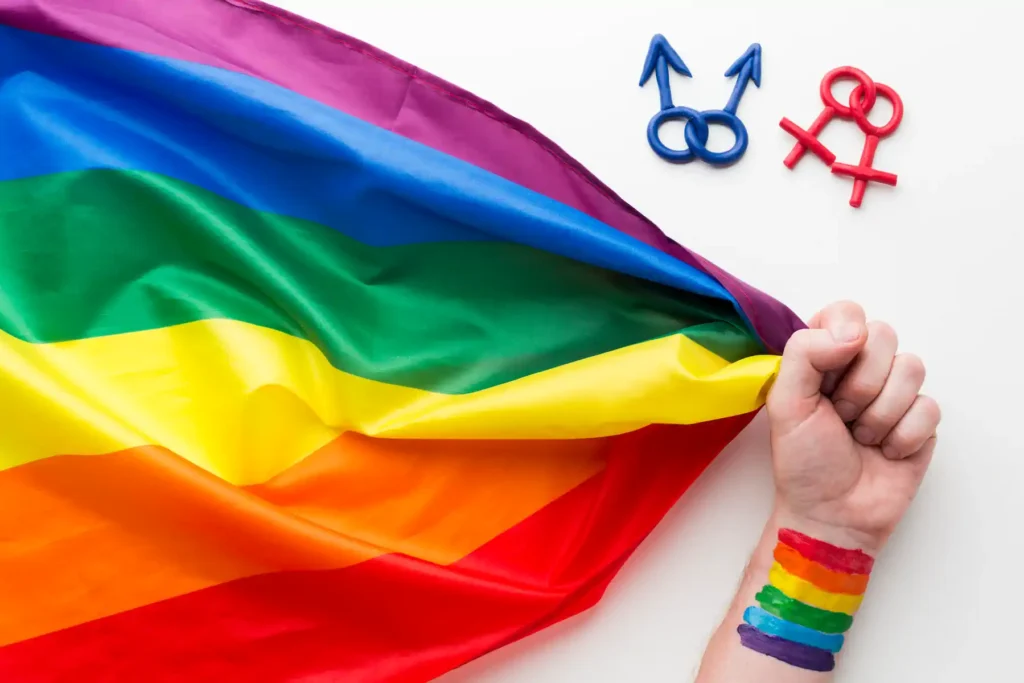
Not all relevant creations within the LGBT+ community are patentable inventions. Some are visual works, cultural signs, or collective symbols. The most prominent example is the rainbow flag, created by Gilbert Baker in 1978.
From an intellectual property standpoint, the rainbow flag is fascinating because it challenges the traditional logic of exclusive appropriation. Rather than becoming a sign controlled by a company or individual, it evolved into a symbol of collective use — reproduced globally in marches, products, campaigns, institutions, trademarks, artistic works, and public spaces.
Its value does not derive from exclusivity, but from social adoption. It is a reminder that not all symbolic assets gain strength by restricting their use. Some become powerful precisely because they circulate freely.
Legally, the case raises relevant questions: copyright over graphic works, the limits of trademark protection over symbols in common use, the risks of commercial appropriation of social symbols, the difference between a business identifier and a community emblem, and the ethical use of identity symbols in brand campaigns.
RuPaul’s Drag Race: trademark, copyright, formats, and cultural franchises
In the entertainment space, RuPaul’s Drag Race stands as one of the most compelling examples of LGBT+ cultural creation transformed into a global intellectual property asset. Its significance is not rooted in a single patent, but in the accumulation of multiple layers of protection: trademarks associated with the show’s name, copyrights over episodes, scripts, music, and audiovisual materials, image rights and contracts with participants, format licenses for international versions, merchandise, live events, streaming platforms, and advertising partnerships.
This case demonstrates that intellectual property does not only protect laboratories and factories — it also protects culture, identity, narrative, and community. In business terms, RuPaul’s Drag Race is an ecosystem of intangible assets: the trademark functions as a commercial umbrella, the audiovisual content as a protected work, the format as a licensed asset, and the show’s participants as extensions of reputational value.
LGBT+ cultural expressions are not merely artistic manifestations — they can also become sophisticated creative industries, with international business models and complex rights structures.
Pride, trademarks, and rainbow washing: the risk of using symbols without coherence
Every June, many companies update their logos with rainbow colors, launch commemorative collections, or publish campaigns in honor of LGBT+ Pride. From a marketing perspective, this can generate affinity with certain audiences. From a legal and reputational standpoint, it can also create risks.
Using symbols associated with a community demands coherence. A company that deploys the rainbow flag as a commercial tool, while lacking genuine internal inclusion policies, may be accused of rainbow washing — co-opting a social cause without authentic commitment.
For intellectual property practitioners, this has several concrete implications: reviewing whether commemorative designs incorporate third-party elements without authorization, confirming that no protected symbols are used without a license, handling the names and images of creators with care, avoiding campaigns that could mislead about sponsorships or institutional affiliations, verifying that trademarks do not attempt to appropriate community symbols in common use, properly documenting collaborations with LGBT+ artists, and regulating through contract the ownership of works, designs, photographs, videos, music, and promotional materials.
Poorly managed inclusion can end in reputational crisis; well-structured inclusion can become a policy of intangible value. Consult with an intellectual property specialist before launching any campaign that uses community symbols.
Intellectual property and inclusion: innovation infrastructure, not a decorative gesture

One of the most common mistakes is treating inclusion as a decorative gesture. From an intellectual property perspective, inclusion should be understood as innovation infrastructure.
An ecosystem that excludes people reduces its creative capacity. One that allows more people to participate expands its base of inventions, trademarks, works, designs, and companies. Diversity does not replace technical excellence — it broadens it. It does not eliminate merit; it allows more merit to compete.
This is especially relevant in sectors such as artificial intelligence, biotechnology, software, design, creative industries, fashion, entertainment, digital health, technology education, and new media. In all of them, personal experience, cultural perspective, and diverse backgrounds can influence how problems are identified, solutions are designed, and commercially relevant products are created.
Lessons for businesses, law firms, and rights holders
Pride Month can be an opportunity for companies to review not only their external communications, but their actual intellectual property strategy. Some concrete actions to consider:
- Identify whether LGBT+ creators, designers, inventors, or collaborators within the organization have contributions that have not been properly recognized or documented.
- Review employment and service contracts to ensure that ownership of inventions, works, and designs is properly regulated.
- Establish internal policies for inclusive innovation.
- Promote intellectual property training for entrepreneurs from underrepresented communities.
- Avoid appropriating community symbols without context, authorization, or coherence.
- Design Pride campaigns with LGBT+ artists under clear, fair, and respectful contracts.
- Protect trademarks and content derived from LGBT+ cultural projects.
- Support diverse ventures through licensing, mentorship, funding, or partnerships.
- Measure the participation of different groups in internal innovation processes.
- Understand that reputation, organizational culture, and intellectual property are connected assets.
An innovation story still being written

The history of innovation is incomplete if the LGBT+ people who have contributed to science, technology, culture, and business are left out. Lynn Conway transformed the microchip industry. Martine Rothblatt has built patent-intensive companies in highly complex sectors. Natalia Bilenko has advanced AI technologies applied to healthcare. Alan Turing laid the conceptual foundations of modern computing. Gilbert Baker created a visual symbol of universal cultural value. RuPaul’s Drag Race shows how a cultural expression can become a global architecture of trademarks, copyrights, formats, and licenses.
Intellectual property has a classic function: to protect creations and encourage innovation. But it also has a contemporary one: to allow more people to participate in the knowledge economy.
The truly relevant question is not whether to change a logo for thirty days. The question is: what are we doing to ensure that all creators, inventors, and entrepreneurs can protect, exploit, and defend their ideas? Because innovation does not ask about sexual orientation before it appears. But the system can decide whether to open the door.
Does your company or project need an intellectual property strategy? Contact us at BE IP and a specialist will guide you.





 English
  Spanish